Countries
In 2025, the Estonian Refugee Council operated in Ukraine, Estonia, Armenia, Georgia, Jordan, Syria and the occupied Palestinian territory, supporting more than 55,000 crisis-affected people with humanitarian assistance and programmes fostering long-term recovery.
Ukraine
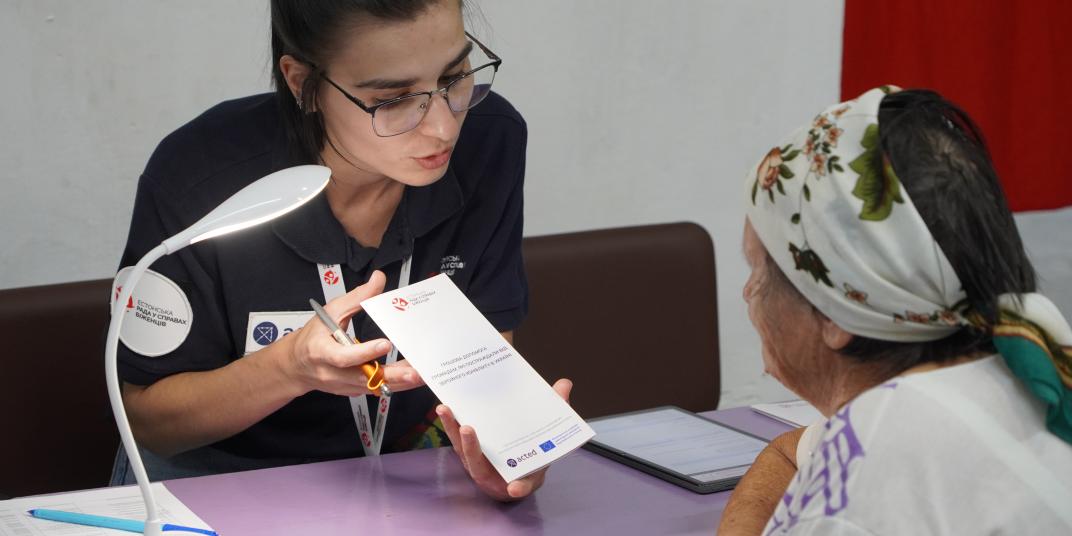
We supported people affected by the war with multi-purpose cash assistance, helping them cover their most essential expenses, like food, medicines, housing, and other basic needs. Last year, our support reached more than 18,000 people in total.
We delivered winterisation assistance to over 8,000 people. In frontline and hard-to-reach areas of eastern and southern Ukraine, we provided both cash and in-kind support to help households cope with rising heating costs and secure heating materials for the winter.
Additionally, more than 1,980 people received cash-based humanitarian assistance for livelihoods activities. This support helped them restore agricultural operations and build resilience through self-sustaining approaches.
We supported more than 800 people with emergency livelihoods assistance to strengthen people’s self-reliance in the war-affected regions of Zaporizhzhia, Dnipropetrovsk, Poltava, Kirovohrad and Cherkasy. The programme supported activities related to agriculture, livestock farming, food production and various services.
Through a counselling hotline, we provided mental health support to Ukrainians both in Ukraine and elsewhere in Europe, helping people cope with the impacts of war. In 2025, we received a total of more than 3,720 calls to the hotline.
Through our entrepreneurship programme, we supported the livelihoods of war-affected people in five regions: Poltava, Kirovohrad, Cherkasy, Dnipro and Kharkiv. The first round of training, which began in September, was successfully completed by 120 entrepreneurs who developed business plans, and 106 of them will receive financial support and four months of mentoring in 2026.
We supported more than 270 people in Dnipropetrovsk oblast and Zaporizhzhia oblast with cash-based assistance for the winter period, enabling them to insulate barns and sustain livestock and poultry activities.
In February, we launched a fundraising campaign Three Years Is Too Many in Estonia, that ran until the end of March, collecting donations to provide essential assistance to vulnerable people in the frontline areas of Ukraine. We raised more than €20,000 to support people who were already in vulnerable situations before the war, including single parents, large families, people with disabilities and older people.
In spring, our Mother’s Day campaign A Gift for Two Mothers raised more than €6,000, which was used to supply women’s hospitals in Zaporizhzhia oblast with essential hygiene items.
In November and December, we raised €30,000 with the support of Estonian donors, to support families in frontline areas of Ukraine with winterisation assistance.
In 2025, the Estonian Refugee Council’s activities in Ukraine were supported by the European Union, the Government of the United States, the United Nations Office for the Coordination of Humanitarian Affairs (OCHA) through the Ukraine Humanitarian Fund (UHF), and the Estonian Ministry of Foreign Affairs. Acted is the lead partner for EU- and US-funded projects. Our partners under the UHF project are Shchedryk and Peaceful Heaven of Kharkiv.
Estonia
We provided counselling and adaptation trainings to support the smooth integration and independent coping of people with a refugee background in Estonia.
- We provided counselling both at our Tallinn office and via email, messaging and telephone. In 2025, more than 570 people received support through our counselling services.
- Over the year, we delivered 156 training sessions on various topics, including the healthcare and social systems, adaptation of parents, adaptation of pensioners, the education system, entrepreneurship, legal issues in Estonia and Ukraine, employment and digital skills. More than 3,200 people with a refugee background participated in these trainings.
- In addition, we are a procurement partner of the Integration Foundation in delivering the national adaptation programme Settle in Estonia. In 2025, more than 2,000 people participated in our trainings.
We organised community events and group activities across Estonia to support people with a refugee background in adapting to their new society. In 2025, more than 1,400 people participated in our community activities.
We carried out seminars supporting the local governments in Estonia on migration and integration-related topics. A total of 60 local government officials and community representatives participated in the seminars, which took place in Järva, Rapla, Viljandi, Lääne-Viru and Ida-Viru counties.
We provided mental health support to people affected by crises and implemented the MindSpring programme across Estonia. Group sessions are led by trained facilitators with similar experiences, backgrounds and languages, fostering trust and a sense of safety. In 2025, 60 people with a refugee background participated in the MindSpring programme in Tallinn, Viljandi and Jõhvi. Sessions were held for adults, young people and parents.
In 2025, together with the International Organization for Migration, we conducted a UNHCR household survey among Ukrainian refugees to assess their well-being and key needs. The Estonian Refugee Council contributed to the study by carrying out 185 interviews.
In spring, we launched a new programme supporting young Ukrainian refugees through language learning and social integration. It included Estonian language meetings based on an immersive language learning methodology developed by Tallinn University. A total of 55 young people took part, 16 of whom graduated from the programme in 2025. Four groups met weekly in Tallinn and two groups in Jõhvi.
We implemented various activities across Estonia to increase the civic engagement of third-country nationals, including beneficiaries of international protection, strengthening mutual understanding and trust and supporting more active participation in society. A total of eight meetups took place across Estonia, including in Narva, Tartu, Tallinn and Pärnu, where nearly 280 people participated.
We also organised events for the local community to raise awareness of forced migration.
- In February, a counselling programme for kindergartens concluded, aimed at strengthening inclusive learning environments.
- In April, a portrait exhibition titled Voices from Crises: Stories of Displaced People, presenting the stories of refugees living in Estonia, was displayed on Vabaduse Boulevard in Tartu. The travelling exhibition opened in Tallinn in spring 2024 and was also showcased in Pärnu.
- On World Refugee Day, 20 June, we organised a youth event in Tondiraba Park to express support for those who have been forced to leave their homes and to encourage greater recognition and appreciation of people from refugee backgrounds in our communities.
- In August, at the Opinion Festival, we organised a discussion on racism in cooperation with the Office of the Gender Equality and Equal Treatment Commissioner and the Estonian Human Rights Centre, titled I’m Not Racist, But… – Real Stories from Estonia, bringing an underrepresented topic in public discourse to wider attention. In the field of foreign policy, the discussion More crises, less funding featured Eero Janson, Director of the Estonian Refugee Council.
We supported the independent livelihoods of people affected by crises by assisting them in starting small businesses and entering the labour market:
- In February, the Boost entrepreneurship programme launched, helping participants develop or relaunch their businesses. A total of 24 teams completed the programme.
- Until March, the third season of the Empowering Women programme, launched in autumn 2024, continued. 26 women-led teams received support, including 14 teams with participants from a refugee background.
- In 2025, in cooperation with Haaga-Helia University of Applied Sciences, we ran two seasons of Start Smart AI-focused training programme for young people with a refugee background, with almost 60 young people taking part.
- In May, the Edge Up programme for jobseekers with a refugee background concluded. The programme was designed to make it easier for people to enter the labour market or move into roles better suited to their skills and experience. In 2025, more than 60 people took part in the “Edge Up” training sessions. The programme was also delivered in Latvia, where it supported over 70 participants.
On 6 November, we hosted Tallinn Humanitarian Conference, bringing together humanitarian experts and organisations from around the world. Held for the third time, the conference focused on three critical themes in the humanitarian sector: institutional reforms and the funding crisis, digital transformation, and access to crisis-affected communities. We welcomed more than 130 participants at the conference.
We celebrated our anniversary: on 6 December, the Estonian Refugee Council marked 25 years of supporting crisis-affected people. Over this period, we have supported more than 470,000 people whose lives have been uprooted by humanitarian crises
In 2025, the Estonian Refugee Council’s activities in Estonia were supported by the City of Tallinn, the Estonian Ecumenical Relief Organisation (EERO Canada), Wise, UNHCR, the Interreg Baltic Sea Region Programme funded by the European Regional Development Fund, Swedbank, OBJEKT, the European Commission, the European Solidarity Corps programme of the European Commission, the British Council, the National Foundation of Civil Society and ESTDEV – the Estonian Centre for International Development. Our partner for the Empowering Women programme was Garage48. In 2025, we were a procurement partner of the Integration Foundation.
Armenia
In 2025, our agricultural programme in Tavush region continued, supporting three schools in adopting water- and energy-efficient agricultural solutions developed in Estonia. We established hydroponic greenhouses and composting units at the schools and worked closely with experts from the Estonian University of Life Sciences to develop comprehensive composting guidelines. A total of 400 students participated in environmental education training, and three people received training that supports their work in the greenhouses.
With support from the European Union, 4 community councils with a total of 78 members, representing 9 out 10 regions in Armenia, were launched, enabling people with a refugee background to voice their concerns, advocate for solutions and participate in decision-making processes affecting them. In addition, we launched 6 self-help groups across Armenia, providing mental health support and strengthening self-reliance. Through these groups, we reached more than 80 people with a refugee background in vulnerable situations, with 37 of them receiving livelihood grants to start income-generating activities. Mentorship was provided to the 27 grantees.
In 2025, the Estonian Refugee Council’s activities in Armenia were supported by the European Union, the Estonian Ministry of Climate through international climate cooperation funds, and the Women’s Fund Armenia.
Georgia
Throughout the year, we strengthened 18 local NGOs and civil society organisations with 27 participants across Georgia through targeted trainings, expert workshops and peer learning, helping them improve internal systems and project management. The programme also encouraged inter-regional cooperation and networking beyond the capital.
In response to ongoing displacement and economic vulnerability, we continued providing cash-based humanitarian assistance to Ukrainian refugees living in Georgia, helping households meet essential daily needs such as food, rent, utilities, healthcare, etc. In total, we provided multi-purpose cash assistance to 395 people.
Recognising the heightened risks during the winter season, we helped Ukrainian refugee families cope with increased winter-related expenses. A total of 180 families (515 people) received targeted cash support to cover critical costs such as heating, electricity, warm clothing, and other seasonal necessities.
Jordan
In November, a programme concluded that supported Syrian refugee and local vulnerable women-headed households in achieving independent livelihoods through smart and climate-friendly agricultural practices. We trained 50 women, and built hydroponic greenhouses for 12 of them.
In 2025, the Estonian Refugee Council’s activities in Jordan were supported by ESTDEV – the Estonian Centre for International Development.
Syria
We opened a representative office in Syria to support people affected by the civil war and help them rebuild their lives.
In November and December, we provided cash-based humanitarian assistance to people in the Latakia region to mitigate the impact of wildfires. A total of 325 people, or 65 families, received support to cover their basic needs.
In 2025, the Estonian Refugee Council’s activities in Syria were supported by the Estonian Ministry of Foreign Affairs. The programme was implemented in cooperation with the Finnish humanitarian organisation Finn Church Aid.
Occupied Palestinian territory
In 2025, we began work in Gaza to provide essential assistance to people affected by the ongoing humanitarian crisis. We launched a fundraising campaign, raising over €14,000 to help deliver food assistance in extremely difficult conditions. With support from the Estonian Ministry of Foreign Affairs and Estonian donors, we distributed more than 12,000 food parcels in hospitals across Gaza, helping to ensure daily meals for both patients and healthcare staff working under severe strain.
In 2025, the Estonian Refugee Council’s activities in the occupied Palestinian territory were supported by the Estonian Ministry of Foreign Affairs and implemented in cooperation with the local organisation Gaza Soup Kitchen.


