
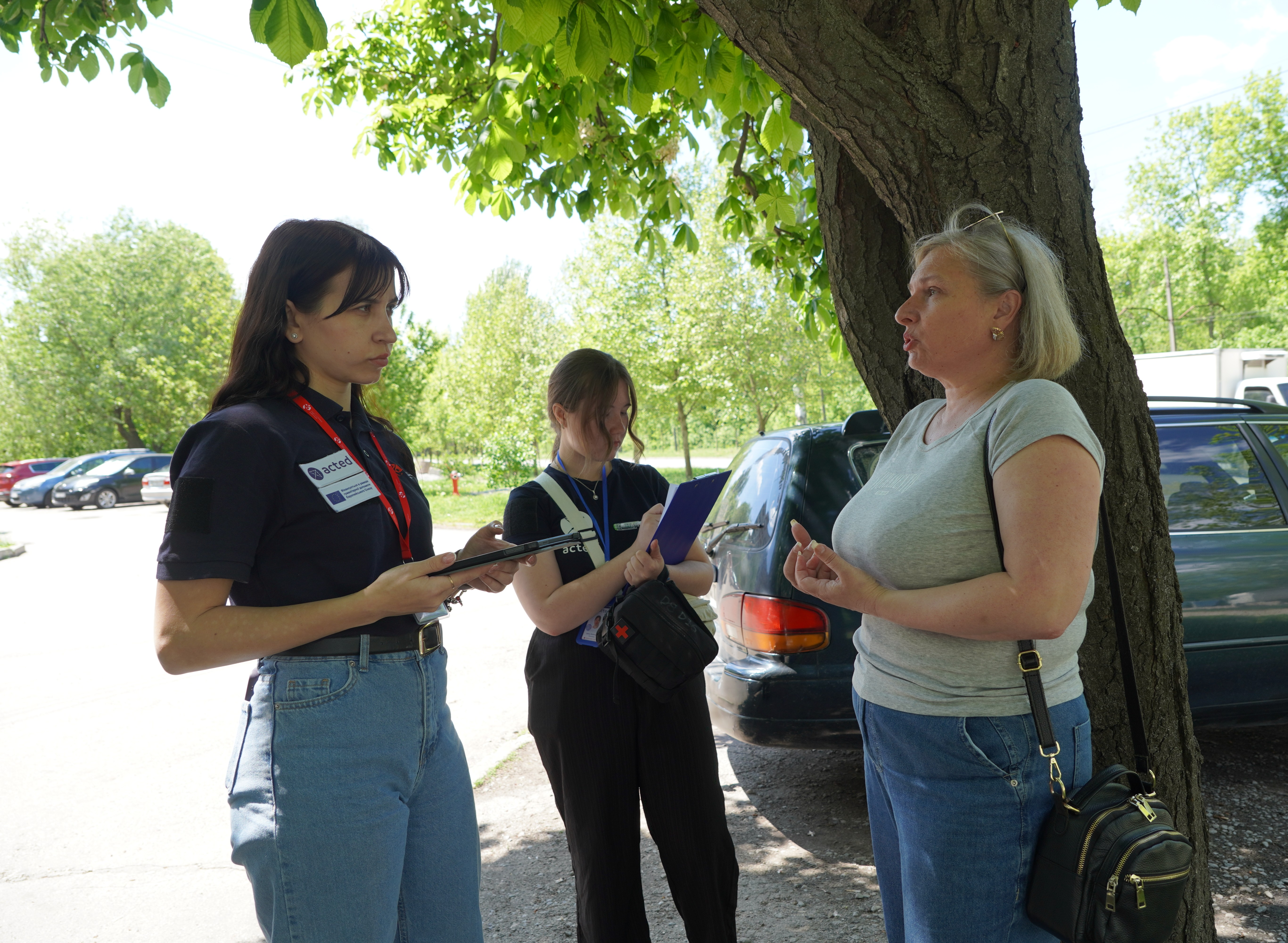
Estonian Refugee Council implements the Emergency Livelihoods Programme funded by the European Union. The aim of the programme is to provide access to livelihood opportunities for vulnerable households affected by the war, create new sources of income, and support people in achieving a basic level of financial stability.
From summer 2025 to spring 2026, vulnerable households living in Dnipropetrovsk, Donetsk, and Zaporizhzhia regions had the opportunity to apply for the programme either online or through paper-based applications. In total, 352 households received cash assistance to start or restore various types of self-employment and microbusiness activities aimed at improving their livelihoods.
Below is the story of a teacher from the Donetsk region who received support through the Programme.
After the start of the full-scale invasion of Ukraine, Sofia’s family’s life changed forever. On March 10, 2022, they were forced to leave their hometown of Vuhledar, Donetska oblast and move to Zaporizhzhia. Since then, the family has been renting an apartment and trying to rebuild their lives under new circumstances.
Sofia is 48 years old and works as a Biology and Chemistry teacher at a school and also provides private tutoring for children of different ages. Together with her husband, who has a disability and requires regular medical treatment, and their 18-year-old daughter, who is a university student, the family has gradually adapted to life in a new city.
“All our income is spent completely on medicines, rent, and basic needs,” Sofia shares.
Due to high expenses, the family has to save wherever possible: buying cheaper products, doing household chores mostly at night to reduce electricity costs, and constantly planning expenses for her husband’s treatments. To afford the necessary medical care, the family saves money for several months in advance.
Despite the challenges, Sofia did not stop working or looking for opportunities to grow. Thanks to her participation in ERC’s “Emergency Livelihoods Support” programme, funded by the EU, and a grant of 42,000 UAH (850 EUR), she was able to purchase equipment for tutoring, including: a laptop, a graphic tablet, a computer mouse, and software for online teaching.
After purchasing the necessary equipment, Sofia immediately began conducting online lessons. According to her, this format of work also helped her expand her circle of acquaintances and social connections. She received the financial assistance in September 2025, and already from December 2025, tutoring began to generate a stable income. Today, she works not only with children in Ukraine, but also with Ukrainian students living abroad, helping them prepare for the National Multi-Subject Test (NMT) and other exams.
Currently, her average tutoring income reaches up to 5,000 UAH (approximately 100 EUR) per month. Although the family still lives modestly, the support helped cover some of their most important expenses and allowed them to feel more confident about the future.
“Now we can pay the apartment rent and cover our basic needs, although not yet at the level we would like,” she says.
Despite all the challenges, Sofia continues making plans for the future. She dreams of creating her own specialised online courses and recruiting new groups of students.
ERC’s programme is implemented in partnership with Acted and through support of the European Union.
Information about the programme is available at the following link: https://lh.pagulasabi.ee/els-ukraine